Showing posts with label Physics. Show all posts

Monday, 15 September 2014

Thank you and Goodbye

Hello,

My last view in the beamline...
So this is my last two days at Diamond. Safe to say, I have enjoyed almost every second... especially when things have worked. However, I still had a very busy last couple of days so...

Thursday I concentrated upon making the track secure. Up until now, I've been using a magnetic mat to hold them down a little more firmly, but this obviously couldn't replace being held down. What was needed was a high-tech, mechanical solution... so naturally I used Velcro. This was not, however, normal Velcro, but industrial strength stuff offered to me by the beamline technician. The glue on the back was incredibly strong, so I was able to use that to hold the magnets firmly in place, whilst experimenting with the 'soft' side as a base.

Otherwise, I spent the day finalising all the documents, such as my report, instruction manual and poster, the latter being sent off to print. This largely involved many pretty pictures and shifting a text box up and down minute distances. All in the name of attractiveness.

...and my last capillaries.
Friday, and my FINAL DAY AT DIAMOND, started peacefully. However, I was told to come to the beamline mid-morning to have a meeting with my supervisor and found a train-shaped cake waiting for me. Baked by my supervisor, it looked wonderful and was delicious and I thank her for it. There was also a gift and card signed by those on my beamline who I've been so lucky to work with.

As I said, though, the last day was still busy, and after eating a slice, I had my Velcro and magnets checked over by an insertion device physicist (who got a slice of cake too for all his help), so I was able to permanently bind them together. The track done, I also cleared up some of my equipment round the lab.

In the afternoon, I was also clearing my desk, but then went into the lab. Partly to finish clearing (I filled a pot of many waste powders I've collected over my weeks at Diamond), but also to load two last capillaries; well, it wouldn't be a last day without doing some. The powders have been through the SQUID and, in such small quantities, are held in the end by a thinner capillary slotted in on top. And guess what? I didn't break ANY whilst preparing them. My training is complete :D

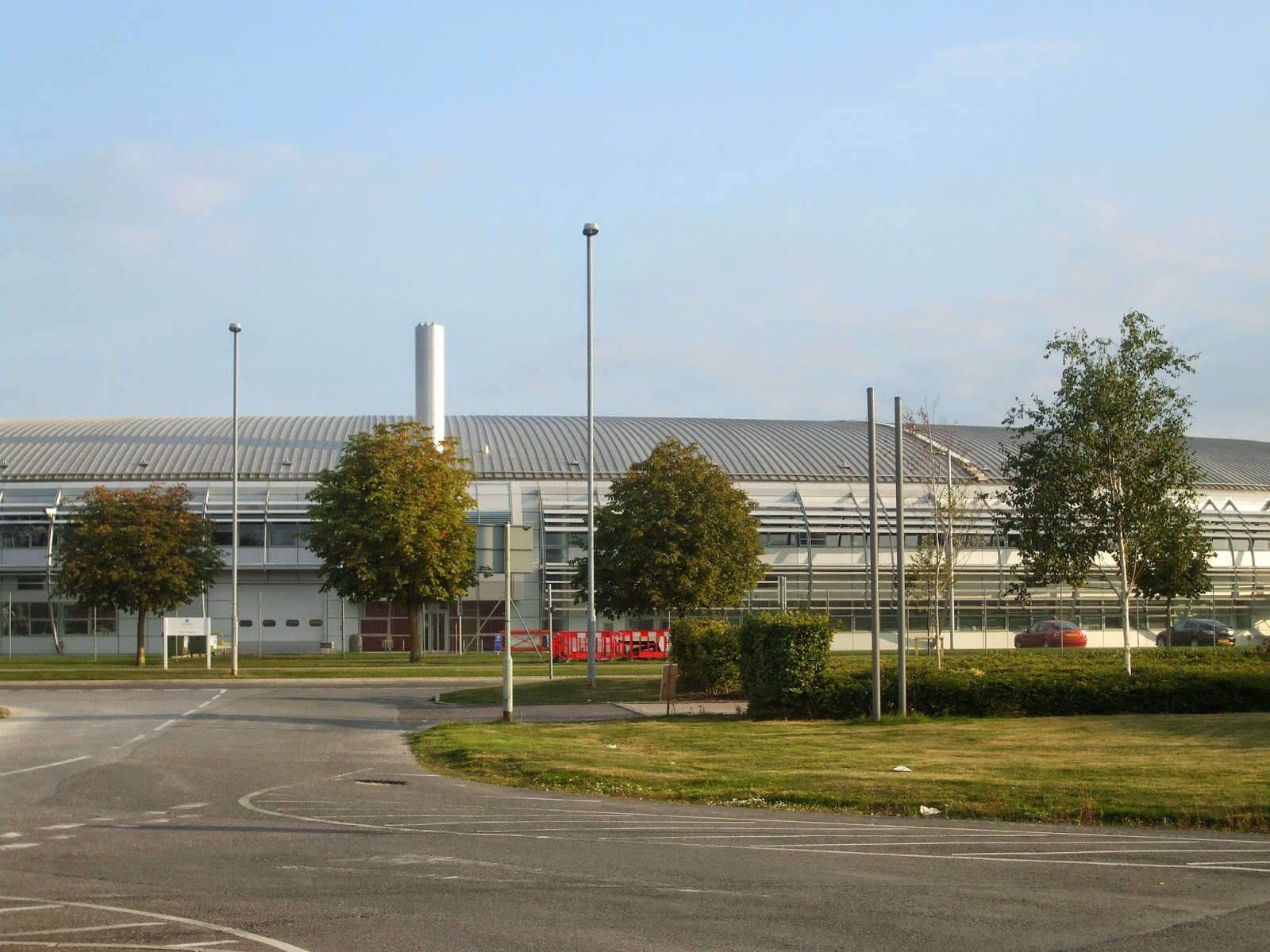
My last view of Diamond.
I'd like to thank everyone for my time at Diamond, including my supervisors, everyone on I11 beamline, the Insertion Device group (for the magnets), comms for their help on the Open Days, all the other placement students and many other scientists and technicians who have helped my train hover. I have had a truly wonderful summer and have learnt so much.

And, of course, thank you to all who have read my blog.
Hover soon (I hope).


Wednesday, 10 September 2014

Demo Days

Hello,

It has been a far colder, more active this week so far, and my last here at Diamond. The weeks have flown by.


Monday was centred around a practice presentation. In the morning, I reviewed my presentation with my supervisor and was able to pick up a few tips to improve it further. By the afternoon, though, I had a mini audience as I gave the talk, this time incorporating a small demonstration along with. I thank all my audience members, who were the staff on the beamline for their attention and suggestions and support when my truck promptly fell apart. I now know not to strap the superconductors on in a hurry.

That afternoon, I also managed to figure out a way of storing the track, at least temporarily. Wrapping the set-up in foil and cardboard allows it to be kept flat and reduce the magnetic field considerably.

Tuesday morning was spent taking on board these suggestions and improving my poster. As mentioned, science posters are a good, visual way to impart information to many people, but they come with the restrictions of space and needing lots of images. Most my time was cutting down sentence size.

The afternoon was a long session with liquid nitrogen and the new superconductors which arrived over the weekend. This allowed me to set up plenty of trials and even attached more superconductors to the train, though in many cases it over-balanced them. However, I gained this footage, for those who've missed my demonstrations. The beeping is my oxygen monitor.


Wednesday started with me setting up the trains again, ready for the real presentation. The whole kit was carried to Diamond House's meeting room and I set it all out on the table. I did manage to catch most the talks, including ones about terahertz radiation to count electron clusters in the beam, steadying a imaging machine and topological insulators (find out more at diamondlifeblog.tumblr.com/post/92147428772)(apologies for bad explanations).

Unfortunately, I missed one talk, setting trains to cool. My presentation seemed to go down well, and I had 4 floating objects which I cycled through in order to let many people see. As mentioned in my speech, people seem to like physical demonstrations.

That afternoon, I was experimenting with bigger trains, along with 2 of the other placement students. They say a picture paints a thousand words so look!


Type soon!
 

Friday, 22 August 2014

Communicating Physics

Hello,
Picture tweeted by @DiamondLightSou of me demonstrating.

Well, I know some of you will have seen what I've been up to this week.

Wednesday was the Open Day. We set up in the beamline between 9-10, ready to show around visitors the beam room and my hovering train. And when the groups started coming, it was non-stop from there forward. For every group, I was presenting a little bit of information about what superconductors are, why they're important and what I was doing with them. Then I got to show them.  No train has been dunked in liquid nitrogen quite so regularly, but I was able, in the most part to demonstrate my project, even performing an old cliché of slipping a piece of paper underneath whilst levitating.

As a nice surprise, many of the other placement students also popped up around lunchtime to watch me perform the levitation. I was really pleased with the response I got not just from them, but from everyone in general, who seemed to enjoy the day; my project is, after all, an Outreach activity and so if I can interest people, even briefly, that's my job complete.

Though busy, it didn't stop us having a little fun near the end of the day as we tried floating little model people (her name is Betsy) in trucks. The results can be seen in this (speeded up I might add) gif:

  http://makeagif.com/cYaVFf
 
The right 2 have been to heavy to hover, but the left three have all been
in the air. His name is Fred.
Thursday was almost inevitably a lot calmer, but I was happy spending the day making the presentation ready for the end of my placement. It did entail though wandering the whole of the way around the synchrotron ring taking a few pictures. Throughout the day though I was trying the think up ways of mounting my track which...


The arrangement for my track - 4 North poles facing up, surrounded by 6 South
poles facing up.


On Friday, I managed using the arrangement to the right. The North poles down the middle created a high magnetic field track, causing a perfect contour for the superconducting disks to follow. The South poles down both sides hold the North poles close together, preventing them from repelling one another too much; any gaps cause the train to unceremoniously fall. This floated my train so successfully, I had to make cardboard buffers as it flew off the end!

 The rest of the day was spent trying to track down more of the little trains I'm using, designing a full length stretch of track and looking for decorations for the train. After all, it'll look nicer with a bit of grass and a station.  

Other events on Friday included giving an interview about me and my placement for Diamond Comms Dep, hoping to also spread Diamond's fame both within and outside Harwell Campus, and some chocolate being left in our office by some of the other placement students. Thanks guys!


Type soon!
PS. Background picture is the capillary furnace glowing in the beamline (found I'd left some pictures on the camera).

Tuesday, 12 August 2014

Culham, Trains and Nightime Beamtime.

Hello,

I do not apologise for the length of this post as it matches this weekend. Working at Diamond is never monotonous.

A model of the inside of JET, the torus tokamak. The plasma is held within the kidney
shaped areas by magnets... and superconductors play their role!
On Thursday morning, I came back to stuffing quartz wool and YBCO salts into open capillaries. By the end, I had manged to fill and mount one, which I felt was quite an achievement. The afternoon, however, I was off to Culham Centre for Fusion Energy. There, they have the world's largest tokamak. With it, they are able to create a plasma out of heavier isotopes of hydrogen (a hydrogen atom with extra neutrons). With it, they are hoping to help find a clean and abundant power source for the future, along with the developing remote handling systems like MASCOT (who looks so like Wall-e). If you want to know more, visit http://www.ccfe.ac.uk/

Friday, however, was back to the trains. Some more empty engine shells had arrived, so I spent my morning patching up wholes and trying them with the superconductors. No joy... yet... The afternoon, I finished creating a spare gas cell capillary because...

Saturday was BEAMTIME! That morning, we attached and aligned the gas cell and hooked it up to the oxygen flow for the gas to flow through. The experiment involved heating the capillary up using a hot air blower and watching for changes.

Leaving it there for several hours, however, didn't actually seem to do much, so we began loading normal capillary (hard as my salts had clumped a little) and set up a low pressure gas experiment, pumping in oxygen. We watched it heat and began writing scripts for overnight dwelling... until the capillary disappeared. As it was getting late at this point, we left it to get some sleep so we were prepared for...

The beamroom at night... not actually that different from day, except
for the peacefulness.
More beamtime Sunday. This turned into a long day. Since the YBCO had to be loaded into really thin capillaries (it absorbs the radiation well), we put this on the back burner so to speak and moved onto another compound. This one, we were able fill into larger capillaries and pump He through in the hope that it could capture some of it. Slowly increasing the pressure, we hoped to see a change in the diffraction pattern.

My little engine, awaiting the judgement by nitrogen.
Whilst analysing these results, we repeated the experiment, but using Oxygen, to try to show whether the He had changed the crystal more than the beam did. To further our evidence, we followed this up with a different compound which shouldn't react with the He at all. With so many experiments and so much capillary heating, we eventually left the beamline at 1.30AM! Diamond at night is so quiet!

Monday morning, (and I do mean 9am-no liein) we came down to our results... only to find the computer script had failed to take the scans! Sad times, but I was able to manually perform the experiment and follow it up with a repetition of the He experiments in the hope of clearer results. I'm now able to mount the samples, lockup the beam room and set scans going.

The afternoon, though, was back to the train and my conclusion was superglue can't cope with liquid nitrogen... oh well. Needless to say, there were many leaks. And 3 broken magnets. Oops.

So to Tuesday, the order of the day was glues. I created samplers of glues and left them to dry over lunch so later in the afternoon I could try them in the liquid nitrogen. They seemed to work so tomorrow, my train is about to get coated!

Type soon!

  PS. It wasn't all work. I've learnt 2 new board games and eaten many biscuits 
whilst waiting for things to heat and pattern emerge.

Wednesday, 6 August 2014

Into the Beam Room

Hello,

 
Starting again on Monday and getting into the week with Beamtime. After gaining a diffraction pattern of the last YBCO I made, the morning was spent attaching the capillary furnace, known as the STOIE, in the beamline; you can see pictures of it to the left. This allows the capillary to be heated more accurately and uniformly than the alternative, the hot air blower, meaning we can get nice diffraction patterns of the YBCO salts heating up.

In principle. After a few coding problems, the furnace started glowing at lower temperatures than expected and the whole experiment switched off early as a safety measure. Turned out, the thermocouple inside was rather damaged, so had to be replaced. Meanwhile, I loaded a capillary of platinum (approx. £10 worth before anyone gets too excited) to use as an alignment help later.

Once working, we started aligning a new salt capillary. This one though provided us with a few difficulties and it was while swapping it for another that I accidentally broke a capillary. Whilst becoming a rarer occurrence, I'm pleased to say, this time it did get stuck in the furnace. In the end, we switch stages (the type of stand in front of the beam) and did 'Rapid Access'; these are samples sent in just for a quick scan.
The STOIE surrounded by the giant detectors.

With the upcoming beamtime over the weekend, on Tuesday I started researching a Plan B for the time then. As a scientist, you must always be prepared for not getting what you expected, because half the time, you're trying something which may not work. For this, I was researching reactions and compounds using the Oxides I'm using for the synthesis (Barium Carbonate, Yttrium Oxide and Copper (II) Oxide).

However, there was a break as I went to a skills session of presentations. It is always useful to be able to talk other people through the work you are doing to encourage interest and further research in the subject.


The gas cell capillary enables gases to flow across the sample in situ.
Wednesday got very cold first thing, as I tried to get a train to levitate with the superconductors attached. Trying several ways and butchering it with pliers, I did get slight lift off the rear of the engine briefly, but the liquid nitrogen poured off almost as fast as it was added.

In the afternoon, I practiced preparing a gas cell capillary. This involves wrapping the sample up in quartz wool and sliding it into an open-ended tube held in a stand as shown. Whilst I didn't break many blank capillaries while practicing loading them into the stand, it turns out the putting cotton-wool-like material is harder than it looks (and it looks hard). However, I didn't break anything while doing it, so tomorrow morning, I should be able to go back and try again.


Type soon.

Tuesday, 29 July 2014

A Variety of Skills

Hello,

The SQUID samples require less material and are MUCH
easier to load - not a toothbrush in sight.
By Friday, I was coming to the end of my time with the SQUID, but managed to get some interesting results from my 9th piece... and it's looking good. However, I've discovered that placing a small sample under 1 T can produce some... interesting and lasting effects. Luckily, I shouldn't get near that with my track.

While the final tests on that were on-going, I attended an Public Engagement Workshop; it's always incredibly to spread the word of science and let people know exactly what we scientists get up to. You can judge how I do with this blog.

The afternoon, I loaded an YBCO capillary ready for some possible sneaky beamtime next week (it's so useful to compare results, with the others) and mixed up some salts in case I suddenly need to bake a new sample.

Over the weekend I had a very long night to watch the Didcot cooling towers come down. A historic moment indeed.

Monday was a slow start, mainly because my bus was very late (ah, roadworks). However, I then got into a Skills session on producing a scientific poster, a good, visual way to display scientific research. If you don't like reading complicated papers, maybe try looking over posters instead. It was followed by a talk from Prospect, a Union focused on Science, Technology, Engineering and Mathematical jobs (STEM). It was interesting to see what they thought the current issues facing scientists were.

All doors to the beam rooms have a traffic light
system to show when you can enter. Red is
firmly stay out.
The afternoon, though, I got back to my science as I cracked out the Liquid Nitrogen again to try hovering a superconductor over my track. And I manage it with both a pre-made disk AND the sample I made the end of last week (Yay!). However, they both warm up rather quickly and can't yet support the heavier train.

Things seems to be taking shape by Tuesday, as I tried to finalise the track design and help the train engine retain the coolness. Huge thanks to the Beamline technician, who hollowed out my engine to form a Nitrogen reservoir and attached the superconductor to the bottom. It was a shame that the train still seems to be heavy and the superconductor aren't quite in cold enough yet. Now trying to source a hollow plastic shell of an engine.
 
Also that day, I attended a very good lecture by Professor Bartolini. It was on the Physics of the Accelerator and explained a lot about the purpose of the dipole and quadrupole magnets to focus the beam. It was interesting to hear about some of the inner workings of the beamline that produces the radiation we use.  

Type soon!

Wednesday, 2 July 2014

Capillary vs. Me & a Toothbrush

Hello,

Allow me to introduce mt partner in crime this post...

The Toothbrush

More specifically, an electric toothbrush.

You probably want some explanation for this. Well, I've started in the lab.

Around the beamlines, there are a number of labs, dealing with the experiments and preparation for the beamline work. This includes a fume cupboard, a vacuum chamber, several furnaces, a scanning electron microscope... amongst lots of other things.

Two things I was being taught to use fresh of Monday morning was the  
  1. Raman spectroscopy In this, molecular vibrations (known as phonons) interacts with photons (little packets of light) from a laser. The photons scatter inelastically; often photons can be absorbed by the sample and re-emitted at a different energy. This shift in energy can be described as a 'fingerprint' of a particular type of molecule. This information can tell us a lot about the bonds and atoms in a molecule.
  2. IR machine performs InfraRed (sic) spectroscopy. It can measure the interactions of a sample with IR light. 
The lovely PostDoc Research Assistant was giving me some tuition in how to use the Raman Spectroscopy. I quickly learnt the hardest thing was to get the machine to focus, but as we were going along, she realised she could use the laser to help pick out a general range before using the light to refine the image before readings were taken. This done, we decided to calibrate the machine using a slide of silicon. One problem: it didn't seem to work.

Never mind. We moved onto the IR machine. This threw up its error message straight away. Given the complexity of the machine, we immediately called another beamline scientist. He poked around for quite a while before declaring that an IT 'expert' had changed something (I think it was the computer) and so the optics card had gone and the software needed to be reinstalled.

This did have a silver lining though. We realised that the reason that the Raman wasn't working was because we'd forgotten to pull up a lever to allow the laser to enter. Whoops!

Lesson learnt though, and I'm glad I learnt it earlier.

Over lunch, I met the new placement students starting. It was nice to hear the other projects and sit in the Sun for a bit - again Didcot has the nice weather.


The afternoon, I went down to the lab with my supervisor and she showed me how to load a capillary (a thin tube of borosilicate or quartz with a funnel at one end - I've tried drawing it... I'll let you try). My beamline specialised in powder diffraction experiments, where fine powders of materials are placed in the beam and the way they interact with the light in studied. The capillaries hold these samples.

To give it a go, I start grinding some Copper Nitrate, a salt I'm using for the superconductor, using a pestle and mortar. About halfway through, we noticed it was getting damp, which causes clumps. I soldiered on though and began to place it in a 0.5mm diameter capillary.

Now, behold the toothbrush!

The vibrational power from it shakes the powder down, settling it at the bottom. Or so it should. Being damp, this didn't happen and I ended up breaking the capillary instead.

Capillary 1  Ros 0

Tuesday and I spent the morning reviewing research on Liquid Nitrogen safety (yes, this included making warning posters and I now know why I did so much poster making at Secondary school), heating YBCO (my superconductor) and phase diagrams on YBCO. My conclusion: there's a lot of research about YBCO in really odd situations, but it's quite hard to find the basics sometimes.

Then, I went down into the lab. And I got exciting news! Given 2 of my materials absorb water from the air like crazy,  I get to use the vacuum chamber to prepare samples of them to give my grinding time.

However, for the afternoon, I started preparing a 0.1 to fit inside a 0.3 mm capillary in order to test a glitter substance of which there are limited amounts. It took a while, but I found a pair which would fit.

Capillary 1  Ros 1

To get practice loading first though, I began loading a 0.7 mm Silicon sample. These are used to calibrate the beamline too, so any which are around will be used. With this is mind, I decided to take my time, teasing the Si down with the toothbrush, using an actual blowtorch to cut the funnel off and carefully gluing it into the capillary holder (it appears superglue really is super enough to be used in the beamline). Then, ever so gently, having spent over an hour preparing it, I screwed the holder into the capillary stand to store. The result:

Capillary 2  Ros 1

On Wednesday, I had a nosey into the beamline as Users were coming in today. What I found was people trying to work on fixing a problem (they occasionally happen, even in a synchrotron) and another beamline caused the beam to be switched off briefly.

I started practicing loading more Si 0.7 mm capillaries. This time, I was more careful and began carefully packing the Si into the tube and using the almighty toothbrush. For Si, it should be quite tightly packed, so I soent a while getting it neatly even.

Capillary 3  Ros 1

 Starting again. By 11.40 though,

Capillary 3  Ros 2

HA!

I then started on the glitter, but just as I finished loading it in, my supervisor appeared.

"Did you grind it?"

I managed to get most of it out.
After lunch, I ground it, and spent a while trying get it into the funnel. The mortar though was too heavy and the powder was now dust. Not willing to admit defeat, my supervisor found a pestle and mortar fit for a mouse. Actually, a mouse might find them a little large. They were incredibly adorable, in a way, and reminded me of the bowls in a doll-house.  

Being careful, with the amount of material left, I regounded gently and tried again.

I tried for an hour and a half (most science is fun, I promise!). The issue was the amount of material, as I scraped the mortar clean, even using the stuff on my gloves, to get only 2 mm of sample. My supervisor, though, thought that given we were fitting a 0.1 capillary inside to make it air-tight it should be OK. Was it? Well;
 
Capillary 4  Ros 2

 The manufacturing leaves a ball of glass at the end thicker than the rest. It wouldn't fit to the end.

The last hour I spent in the beamline, whose experiment was up and running. I'm still gathering details on it, as it's running over several days, so I hope to be able to share a proper explanation at some point.

In terms of Me vs. the capillaries, well...

TBC

PS. Talking to another intern at the end of the day: he also used the toothbrush trick. See, it's a valid scientific method.

   (PPS. All pictures from clipart)