Showing posts with label Synchrotron. Show all posts

Monday, 15 September 2014

Thank you and Goodbye

Hello,

My last view in the beamline...
So this is my last two days at Diamond. Safe to say, I have enjoyed almost every second... especially when things have worked. However, I still had a very busy last couple of days so...

Thursday I concentrated upon making the track secure. Up until now, I've been using a magnetic mat to hold them down a little more firmly, but this obviously couldn't replace being held down. What was needed was a high-tech, mechanical solution... so naturally I used Velcro. This was not, however, normal Velcro, but industrial strength stuff offered to me by the beamline technician. The glue on the back was incredibly strong, so I was able to use that to hold the magnets firmly in place, whilst experimenting with the 'soft' side as a base.

Otherwise, I spent the day finalising all the documents, such as my report, instruction manual and poster, the latter being sent off to print. This largely involved many pretty pictures and shifting a text box up and down minute distances. All in the name of attractiveness.

...and my last capillaries.
Friday, and my FINAL DAY AT DIAMOND, started peacefully. However, I was told to come to the beamline mid-morning to have a meeting with my supervisor and found a train-shaped cake waiting for me. Baked by my supervisor, it looked wonderful and was delicious and I thank her for it. There was also a gift and card signed by those on my beamline who I've been so lucky to work with.

As I said, though, the last day was still busy, and after eating a slice, I had my Velcro and magnets checked over by an insertion device physicist (who got a slice of cake too for all his help), so I was able to permanently bind them together. The track done, I also cleared up some of my equipment round the lab.

In the afternoon, I was also clearing my desk, but then went into the lab. Partly to finish clearing (I filled a pot of many waste powders I've collected over my weeks at Diamond), but also to load two last capillaries; well, it wouldn't be a last day without doing some. The powders have been through the SQUID and, in such small quantities, are held in the end by a thinner capillary slotted in on top. And guess what? I didn't break ANY whilst preparing them. My training is complete :D

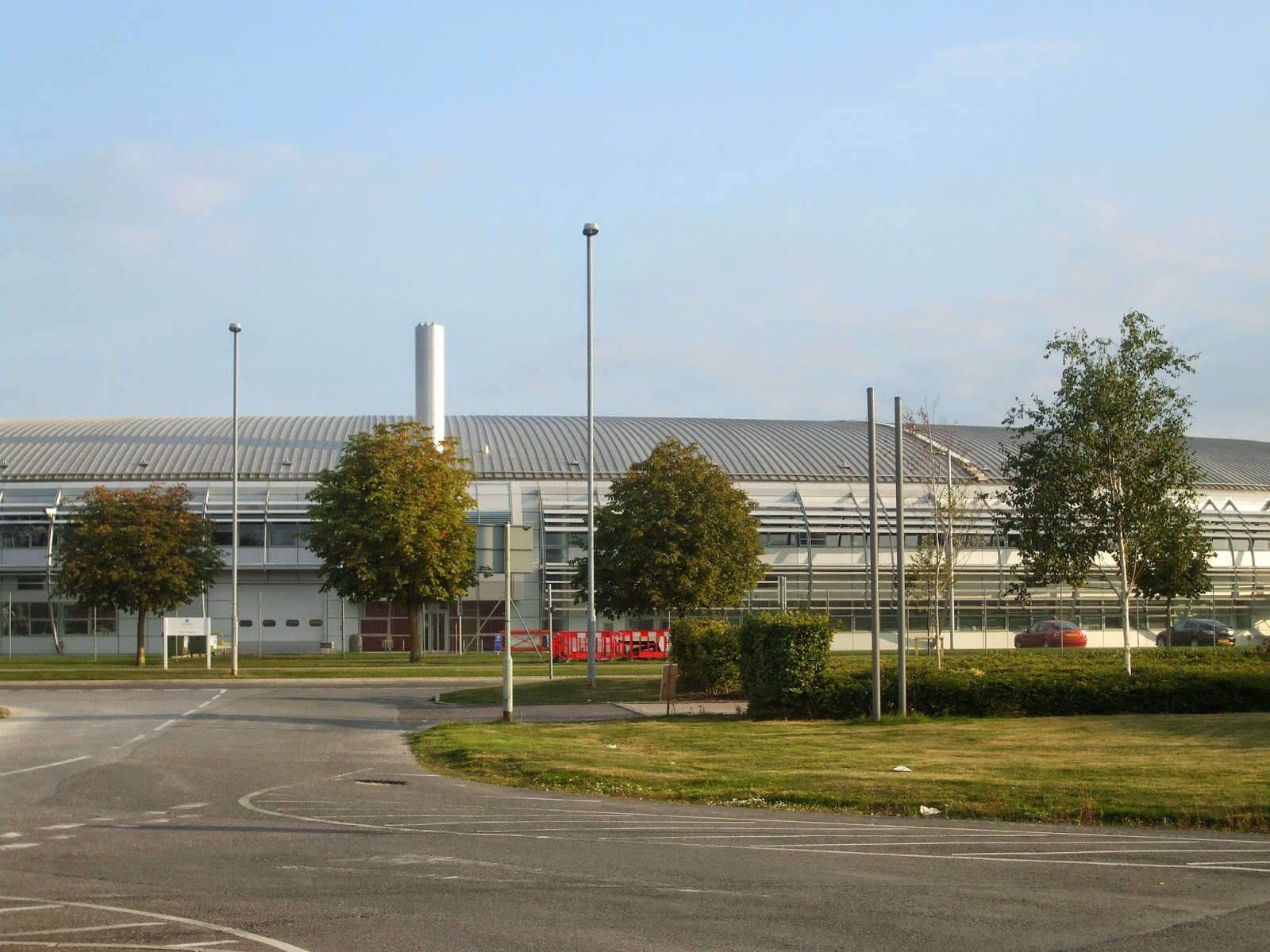
My last view of Diamond.
I'd like to thank everyone for my time at Diamond, including my supervisors, everyone on I11 beamline, the Insertion Device group (for the magnets), comms for their help on the Open Days, all the other placement students and many other scientists and technicians who have helped my train hover. I have had a truly wonderful summer and have learnt so much.

And, of course, thank you to all who have read my blog.
Hover soon (I hope).


Friday, 22 August 2014

Communicating Physics

Hello,
Picture tweeted by @DiamondLightSou of me demonstrating.

Well, I know some of you will have seen what I've been up to this week.

Wednesday was the Open Day. We set up in the beamline between 9-10, ready to show around visitors the beam room and my hovering train. And when the groups started coming, it was non-stop from there forward. For every group, I was presenting a little bit of information about what superconductors are, why they're important and what I was doing with them. Then I got to show them.  No train has been dunked in liquid nitrogen quite so regularly, but I was able, in the most part to demonstrate my project, even performing an old cliché of slipping a piece of paper underneath whilst levitating.

As a nice surprise, many of the other placement students also popped up around lunchtime to watch me perform the levitation. I was really pleased with the response I got not just from them, but from everyone in general, who seemed to enjoy the day; my project is, after all, an Outreach activity and so if I can interest people, even briefly, that's my job complete.

Though busy, it didn't stop us having a little fun near the end of the day as we tried floating little model people (her name is Betsy) in trucks. The results can be seen in this (speeded up I might add) gif:

  http://makeagif.com/cYaVFf
 
The right 2 have been to heavy to hover, but the left three have all been
in the air. His name is Fred.
Thursday was almost inevitably a lot calmer, but I was happy spending the day making the presentation ready for the end of my placement. It did entail though wandering the whole of the way around the synchrotron ring taking a few pictures. Throughout the day though I was trying the think up ways of mounting my track which...


The arrangement for my track - 4 North poles facing up, surrounded by 6 South
poles facing up.


On Friday, I managed using the arrangement to the right. The North poles down the middle created a high magnetic field track, causing a perfect contour for the superconducting disks to follow. The South poles down both sides hold the North poles close together, preventing them from repelling one another too much; any gaps cause the train to unceremoniously fall. This floated my train so successfully, I had to make cardboard buffers as it flew off the end!

 The rest of the day was spent trying to track down more of the little trains I'm using, designing a full length stretch of track and looking for decorations for the train. After all, it'll look nicer with a bit of grass and a station.  

Other events on Friday included giving an interview about me and my placement for Diamond Comms Dep, hoping to also spread Diamond's fame both within and outside Harwell Campus, and some chocolate being left in our office by some of the other placement students. Thanks guys!


Type soon!
PS. Background picture is the capillary furnace glowing in the beamline (found I'd left some pictures on the camera).

Tuesday, 12 August 2014

Culham, Trains and Nightime Beamtime.

Hello,

I do not apologise for the length of this post as it matches this weekend. Working at Diamond is never monotonous.

A model of the inside of JET, the torus tokamak. The plasma is held within the kidney
shaped areas by magnets... and superconductors play their role!
On Thursday morning, I came back to stuffing quartz wool and YBCO salts into open capillaries. By the end, I had manged to fill and mount one, which I felt was quite an achievement. The afternoon, however, I was off to Culham Centre for Fusion Energy. There, they have the world's largest tokamak. With it, they are able to create a plasma out of heavier isotopes of hydrogen (a hydrogen atom with extra neutrons). With it, they are hoping to help find a clean and abundant power source for the future, along with the developing remote handling systems like MASCOT (who looks so like Wall-e). If you want to know more, visit http://www.ccfe.ac.uk/

Friday, however, was back to the trains. Some more empty engine shells had arrived, so I spent my morning patching up wholes and trying them with the superconductors. No joy... yet... The afternoon, I finished creating a spare gas cell capillary because...

Saturday was BEAMTIME! That morning, we attached and aligned the gas cell and hooked it up to the oxygen flow for the gas to flow through. The experiment involved heating the capillary up using a hot air blower and watching for changes.

Leaving it there for several hours, however, didn't actually seem to do much, so we began loading normal capillary (hard as my salts had clumped a little) and set up a low pressure gas experiment, pumping in oxygen. We watched it heat and began writing scripts for overnight dwelling... until the capillary disappeared. As it was getting late at this point, we left it to get some sleep so we were prepared for...

The beamroom at night... not actually that different from day, except
for the peacefulness.
More beamtime Sunday. This turned into a long day. Since the YBCO had to be loaded into really thin capillaries (it absorbs the radiation well), we put this on the back burner so to speak and moved onto another compound. This one, we were able fill into larger capillaries and pump He through in the hope that it could capture some of it. Slowly increasing the pressure, we hoped to see a change in the diffraction pattern.

My little engine, awaiting the judgement by nitrogen.
Whilst analysing these results, we repeated the experiment, but using Oxygen, to try to show whether the He had changed the crystal more than the beam did. To further our evidence, we followed this up with a different compound which shouldn't react with the He at all. With so many experiments and so much capillary heating, we eventually left the beamline at 1.30AM! Diamond at night is so quiet!

Monday morning, (and I do mean 9am-no liein) we came down to our results... only to find the computer script had failed to take the scans! Sad times, but I was able to manually perform the experiment and follow it up with a repetition of the He experiments in the hope of clearer results. I'm now able to mount the samples, lockup the beam room and set scans going.

The afternoon, though, was back to the train and my conclusion was superglue can't cope with liquid nitrogen... oh well. Needless to say, there were many leaks. And 3 broken magnets. Oops.

So to Tuesday, the order of the day was glues. I created samplers of glues and left them to dry over lunch so later in the afternoon I could try them in the liquid nitrogen. They seemed to work so tomorrow, my train is about to get coated!

Type soon!

  PS. It wasn't all work. I've learnt 2 new board games and eaten many biscuits 
whilst waiting for things to heat and pattern emerge.

Wednesday, 6 August 2014

Into the Beam Room

Hello,

 
Starting again on Monday and getting into the week with Beamtime. After gaining a diffraction pattern of the last YBCO I made, the morning was spent attaching the capillary furnace, known as the STOIE, in the beamline; you can see pictures of it to the left. This allows the capillary to be heated more accurately and uniformly than the alternative, the hot air blower, meaning we can get nice diffraction patterns of the YBCO salts heating up.

In principle. After a few coding problems, the furnace started glowing at lower temperatures than expected and the whole experiment switched off early as a safety measure. Turned out, the thermocouple inside was rather damaged, so had to be replaced. Meanwhile, I loaded a capillary of platinum (approx. £10 worth before anyone gets too excited) to use as an alignment help later.

Once working, we started aligning a new salt capillary. This one though provided us with a few difficulties and it was while swapping it for another that I accidentally broke a capillary. Whilst becoming a rarer occurrence, I'm pleased to say, this time it did get stuck in the furnace. In the end, we switch stages (the type of stand in front of the beam) and did 'Rapid Access'; these are samples sent in just for a quick scan.
The STOIE surrounded by the giant detectors.

With the upcoming beamtime over the weekend, on Tuesday I started researching a Plan B for the time then. As a scientist, you must always be prepared for not getting what you expected, because half the time, you're trying something which may not work. For this, I was researching reactions and compounds using the Oxides I'm using for the synthesis (Barium Carbonate, Yttrium Oxide and Copper (II) Oxide).

However, there was a break as I went to a skills session of presentations. It is always useful to be able to talk other people through the work you are doing to encourage interest and further research in the subject.


The gas cell capillary enables gases to flow across the sample in situ.
Wednesday got very cold first thing, as I tried to get a train to levitate with the superconductors attached. Trying several ways and butchering it with pliers, I did get slight lift off the rear of the engine briefly, but the liquid nitrogen poured off almost as fast as it was added.

In the afternoon, I practiced preparing a gas cell capillary. This involves wrapping the sample up in quartz wool and sliding it into an open-ended tube held in a stand as shown. Whilst I didn't break many blank capillaries while practicing loading them into the stand, it turns out the putting cotton-wool-like material is harder than it looks (and it looks hard). However, I didn't break anything while doing it, so tomorrow morning, I should be able to go back and try again.


Type soon.

Tuesday, 29 July 2014

A Variety of Skills

Hello,

The SQUID samples require less material and are MUCH
easier to load - not a toothbrush in sight.
By Friday, I was coming to the end of my time with the SQUID, but managed to get some interesting results from my 9th piece... and it's looking good. However, I've discovered that placing a small sample under 1 T can produce some... interesting and lasting effects. Luckily, I shouldn't get near that with my track.

While the final tests on that were on-going, I attended an Public Engagement Workshop; it's always incredibly to spread the word of science and let people know exactly what we scientists get up to. You can judge how I do with this blog.

The afternoon, I loaded an YBCO capillary ready for some possible sneaky beamtime next week (it's so useful to compare results, with the others) and mixed up some salts in case I suddenly need to bake a new sample.

Over the weekend I had a very long night to watch the Didcot cooling towers come down. A historic moment indeed.

Monday was a slow start, mainly because my bus was very late (ah, roadworks). However, I then got into a Skills session on producing a scientific poster, a good, visual way to display scientific research. If you don't like reading complicated papers, maybe try looking over posters instead. It was followed by a talk from Prospect, a Union focused on Science, Technology, Engineering and Mathematical jobs (STEM). It was interesting to see what they thought the current issues facing scientists were.

All doors to the beam rooms have a traffic light
system to show when you can enter. Red is
firmly stay out.
The afternoon, though, I got back to my science as I cracked out the Liquid Nitrogen again to try hovering a superconductor over my track. And I manage it with both a pre-made disk AND the sample I made the end of last week (Yay!). However, they both warm up rather quickly and can't yet support the heavier train.

Things seems to be taking shape by Tuesday, as I tried to finalise the track design and help the train engine retain the coolness. Huge thanks to the Beamline technician, who hollowed out my engine to form a Nitrogen reservoir and attached the superconductor to the bottom. It was a shame that the train still seems to be heavy and the superconductor aren't quite in cold enough yet. Now trying to source a hollow plastic shell of an engine.
 
Also that day, I attended a very good lecture by Professor Bartolini. It was on the Physics of the Accelerator and explained a lot about the purpose of the dipole and quadrupole magnets to focus the beam. It was interesting to hear about some of the inner workings of the beamline that produces the radiation we use.  

Type soon!

Tuesday, 15 July 2014

Beamtime!

Hello

I start by saying I hope to get my camera into a lab soon. But the past few days, I've been rather busy as I went...

From hot to cold these past few days. It started Friday, when I has not one but two furnaces heating away as I worked on another batch of capillaries. Having made:
The tablets go from a clay colour to black when heated
  •  pelleted and pelleted-halfway-through-heating (phth as I will now call it... 'cos I'm lazy) superconductor in air
  •  a unpelleted and phth superconductor with a low flow of oxygen (and the furnace did switch off and I did jump for joy)
  the final combination was pelleted in oxygen and unpelleted in air. Since the latter didn't required oxygen, I used the box furnaces instead.

This wouldn't have been so bad if I hadn't been making more capillaries from samples of the last four pellets in the room next door. Phew! And for the mathematician who likes to have a scoreboard:


Capillary 5  Ros 10

I also made a capillary of the salts mixed but not heated because...
Monday I had beamtime!
What's more, I froze! A student on a brief bit of work experience has a small project and for it there were three of us grinding up samples to compared usin7g the beam. And my sample needed to be kept cool, so I did it in the fridge. 
I say three of us, since there was also another intern getting a taste of lab life; he's designing software to help with the data collected on our beamline and came to have a look at what we do. Goes to show, there are a lot of people working outside the beamline rooms to get it running smoothly.
The afternoon, we actually placed  14 samples (including my superconductor samples and mixed salts) into the beam in order to get results. The beam hit the sample and we took a diffraction pattern using the detectors that surround the capillaries. The equipment at Diamond is really highly sensitive and so it gave rather wiggly lines, but by the end, I could make out distinct peaks showing a change from the mixed salt to the cooked superconductors.

Overnight, we left the detectors taking periodic scans of the mixed salts being heated and cooled in situ so we look at the phase change. That's right: I'm doing an experiment using a synchrotron.
The beamline has a traffic light warning system. Red means 'No Entry'. And yes, I hope to get a proper photo.
Coming in Tuesday morning, I'd found my capillary had... well... exploded overnight. On the bright side though, most of the measurements had been made by that point and were waiting to be analysed. 

However, the day was rather busy. There were new users setting up, a meeting with a H&S man, who told us about the 5S process of organisation, a beamline safety meeting (extremely important), tidying up in the lab ready for the monthly Health and Safety checks (like I said, extremely important) and capillaries to load of the superconductors made on Friday. 

The data rather feel by the side for the day, but we did establish that the salts would need to be mixed in a quartz capillary to survive the heating. 

Last job of the day was to put on a new superconductor to cook. I feel I'm becoming quite  chef.

And the final capillary count (inc. the colder attempts):

Capillary 9  Ros 13
 Still winning.
Type soon!
Picture from Clipart.

Thursday, 10 July 2014

Out of Mortar, Into the Furnace

Hello,


The past few days have been fairly warm across my area of the UK. And, as a typical British person, I must complain about its timing. Just when I have to share a lab with a furnace.

On Tuesday, it was decided that it would be a good opportunity for me to get to know the tube furnace I'll be baking the superconductor in. As previous readers know, this experienced a minor set-back last week when my previous attempt at YBCO sort of... well... micro-exploded in there. Thus, when I came to having a go at practical trials after reading the instruction booklet, I found that the inside was covered in black, partially burnt nitrate mix. Eww...

Luckily, my beamline manager gave me a hand at clearing it out, using towels and solvents. Being nitrates, we also got to use dust masks... and I realised I've never had to use one before. Yes, I tried to put it on sideways first attempt.

The solvents needed time to dry though, so I came back to it in the afternoon and set it on a quick heating cycle. Just up to 250 degrees Celsius at 5 degrees a minutes and then hold for half an hour. This seems trivial, especially when you think some ovens can do that, but simple practice allowed me to monitor the cooldown rate too.

While this was heating, I was also able to prepare miniature glass vials of Yttrium Oxide, ready for synthesis. We're still waiting on the copper oxide.
The outside of Diamond. The large canister is filled with Liquid Nitrogen... though I don't think I'll be using all of that!

This had arrived by Wednesday, so that morning I was able to start grinding up all the salts together to create my first batch of superconductor using the Oxides. And it didn't turn to paste. Instead, it was a dusty, clay-coloured substance, which I was able to press into a mini pellets of superconductor and stick in the oven.

I was also able to make a second boat of mixture, but this one without pressing. Why? Because we're still experimenting with the process of making the superconductor; we're trying several techniques to see which works best. Science can sometimes be trial and error.

While it was cooking, I prepared two boats of salts to cook tomorrow. I also tried to make a capillary of the nitrate mix... and I tried again... well, maybe another day. *sigh* Before the end of the day, I took out the second boat of unpressed salts, reground, pelleted and replaced it. Just to see what happens.
To the left, you can see the bridge that allows access to Diamond. It is slightly like entering a spaceship, I won't lie.

I came in on Thursday to find the furnace hadn't cut out after ten hours like I thought I'd set it. I blame it on fiddling about with the settings after it had started. Never mind, I let the superconductor cool and was able to load the new boats in and set them off, this time under a flow of oxygen. And yes, I got to make pretty warning signs. I then mixed up two new boats for Friday's firing. 

Once cool, I ground up a little of the second superconductor to place in a capillary... Second attempt lucky. In between this, I was able to sneak into the beamline to watch a new experiment being set up. And I hope to learn more.

My final task was to withdraw one of the boats to regrind and pelleted before replacing. Every angle covered. Now I must hope the furnace switches off over night. Not least, because it makes the lab pretty warm. Well, I am setting it to 930 degrees C.

Type soon. 

Monday, 7 July 2014

Sort of Synthesising

Hello,

On Thursday, the view of my day was mainly this:


This is the view from my desk in Diamond. As you can see, I'm actually in the Synchrotron building itself, with the walkway outside. From there, you can look down onto the beamline control and hutches or across at the slabs of concrete that provide the shielding around the main beam circuit (see below). Some days, you can even watch the built-in crane lift the slabs as engineers get underneath.
 
I was mainly researching Thursday, checking phase patterns and the absorption of my superconductor if it was put in the beamline - too absorbing and there's little point in placing it in the beamline as there wouldn't be a diffraction pattern. However, I also had two training sessions so I can use all types of fire extinguishers and the library at Harwell campus. So, all pretty useful skills.

Friday, though, I was back in the lab, actually synthesising superconductor. Or at least trying too.

Using the balance was a skill in itself, especially since I'm trying to measure quantities to three decimal places. The gusts in the fume cabinet have a large effect at this level of precision. The scales have their own doors to exclude the draught.

I then grind the salts together into a powder... which is where it started to go a bit wrong. I mentioned that Yttrium Nitrate and Copper Nitrate absorbs water in the air. Well, soon I had a paste instead of a powder. Trying to make this into an even colour is more challenging and so it took more mixing than expected. But at least it was a very nice blue.

It then went in the tube furnace at 850 degrees Celsius with the oxygen cylinder hooked up. And it stayed there for almost a whole minute.

By then, it was bubbling and spitting everywhere. It was quickly pulled out before any real damage was down. Disappointing, but part of science; things rarely go to plan, but that's how things are discovered.

In light of this, we've (my supervisor and I) have decided to change the starting materials. I'm now going to try Yttrium Oxide, Barium Carbonate and Copper Oxide. 
Above the beamline. Everything yellow contains lead shielding.


The Oxides hadn't arrived by Monday, but that didn't mean the day went to waste. I spent the morning filling two 0.3 mm capillaries with Barium Nitrate and Barium Carbonate. Because I'm now in a place which has a lot of Barium Carbonate sitting around. As can happen. This is purely for interest's sake, but obtaining results from anything I've made on the beamline would be pretty awesome. And now...

Capillary 4  Ros 4
It would appear practice does make... a draw at least.

The afternoon I decided to get a head-start on the new synthesis process by measuring out all the Barium Carbonate. At the end of the day, I left 11 glass vials of BaCO3 sitting on the side, ready and waiting. And the scales only played up once! (they autocalibrated).

Type soon!